

Introduction to Investment Strategist
Whether you’re an aspiring finance professional or simply curious about the hidden architect of asset-allocation decisions, understanding the role of an investment strategist is essential. In this deep dive, we’ll explore what an investment strategist does, compare it with other roles, spell out the skills, education path, tools, salary terrain, how to become one in 2025+, and where the field is headed.
 Related Read: If you’re planning larger investments, learn how to Calculate HELOC Payment Easily.
What Is an Investment Strategist?
An investment strategist is a finance-professional who lives in the overlap of macro-economics, asset-allocation theory, market research and client/institutional advising. In many asset management firms, hedge funds or private wealth offices, the investment strategist is the person who asks “Where are we going? What could happen? What do we believe?” — and then designs the strategic lens through which portfolios are built.
For example, the CFA Institute describes investment strategists as “macro-market commentators or advisors and insight generators who analyse economic indicators (eg rates, currencies) and advise portfolio managers on strategic and tactical asset allocation and trading strategies.” CFA Institute
Another breakdown says that the investment strategist “formulates and advocates for long-term investment plans to achieve specific financial objectives,” requiring deep understanding of financial markets, economic trends, and asset classes.
Why the role matters
As markets become more global, more complex and more driven by macro forces (inflation, central banks, geopolitics, ESG), having someone whose job is to synthesise and prognosticate becomes a competitive edge.
They help translate economic shifts into actionable allocation decisions (which asset class should overweight, which underweight).
They serve as a bridge between research, portfolio management, clients and the broader market narrative.
For institutional investors and high-net-worth wealth clients, the strategist gives coherence (and narrative) to what might otherwise be chaotic or fragmented investment decisions.
Core Responsibilities
Here’s a breakdown of what an investment strategist typically does on the job:
Market and economic research – Monitoring global macro-variables (interest rates, inflation, currencies, trade flows, policy changes). Example: according to job descriptions, conducting market research and analysing economic and industry trends is a core task.
Asset allocation strategy – Crafting both strategic (long-term) and tactical (short to medium term) asset-allocation frameworks: which mix of equities, bonds, alternatives, real assets, etc.
Portfolio construction input – While the portfolio manager might execute trades, the strategist guides the oversight: recommending sector tilts, regional exposures, thematic plays, risk overlays. One description mentions “uses in-depth subject matter expertise… advises family portfolios through the full cycle… strategic asset allocation, tactical allocation…”
Scenario analysis and stress-testing – Running “what if” scenario models: What if inflation spikes? What if central banks pivot? How might equities respond? These feed into positioning.
Client/institutional communication – Translating complex ideas into digestible insights for clients, internal stakeholders, senior management. Building confidence. As one resource says: “Continuously monitors the markets and adjust strategies accordingly… must convey complex financial concepts in an accessible manner.”
Monitoring & performance review – Watching how portfolios perform relative to strategy, assessing attribution (why returns came in as they did), adjusting outlooks.
Collaborating with other teams – Working with research analysts, portfolio managers, compliance/legal, investment operations, client teams. One job ad noted the strategist “works with Global Market Strategists… researches macro/market topics… builds tools…
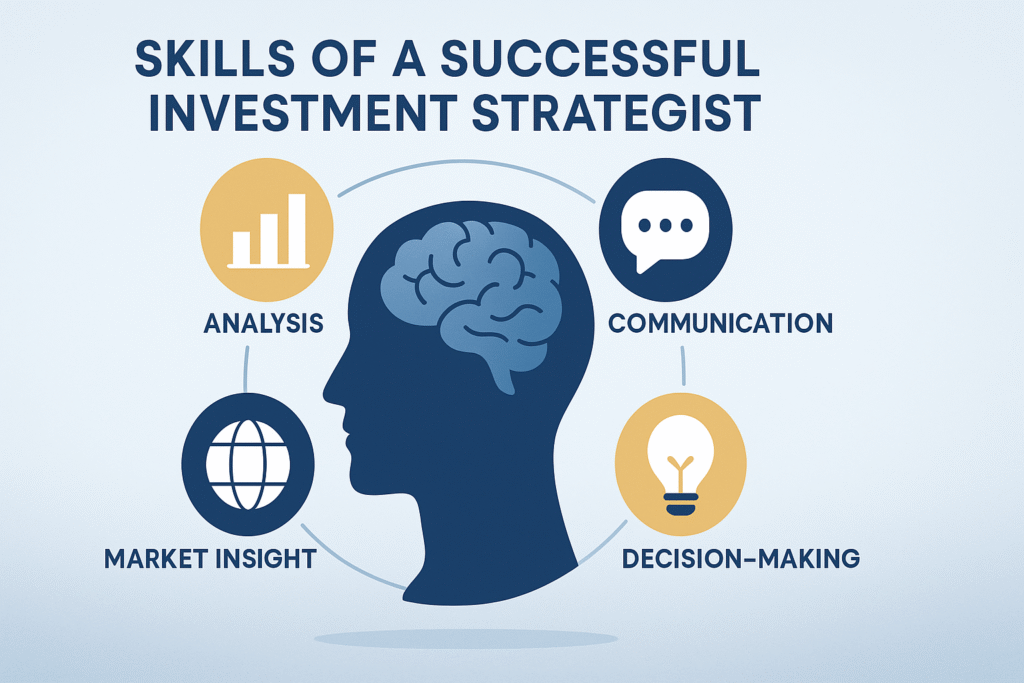
Tools & Technologies Used
Bloomberg Terminal / Reuters Eikon – Real-time market data, news, economic indicators, fixed income/currency data.
Excel / VBA / Advanced Modelling – Building asset-allocation models, scenario stress-tests, attribution analyses.
Statistical/quant platforms – Some use R, Python, MATLAB for advanced analysis, particularly when they work with big data or alternative assets.
Portfolio optimisation tools – Software that supports mean-variance optimisation, Monte Carlo simulation, risk-budgeting.
AI/analytics dashboards – Firms increasingly use AI to analyse alternative data sets (satellite imagery, sentiment, ESG data) and feed into strategy. Academic research shows deep-learning frameworks are used for robo-advising and portfolio optimisation. arXiv
Client/presentation software – PowerPoint, Tableau, interactive microsites: one job description noted the strategist “researches macro/market topics… develops novel and innovative methods for representing views… across multiple mediums (digital, podcasts, interactive microsites)”. Wall Street Friends
Tip for aspirants
Familiarise yourself with Excel modelling, basic Python or R for finance, get comfortable reading macro data, and learn how to tell the story behind the numbers.
Educational Path & Certifications
Education
Bachelor’s degree in finance, economics, business, mathematics or related field. Most roles list this as minimum.
A master’s/MBA is often valuable for advancing into senior strategist roles; having deeper macroeconomics/finance specialisation helps.
Certifications
- The CFA Institute Chartered Financial Analyst (CFA) credential is highly regarded in this space. CFA notes strategists often hold the designation.
- For those involved in wealth or retail clients, the CFP (Certified Financial Planner) might be useful (though less common for pure strategist roles).
- Additional certifications: FRM (Financial Risk Manager), CAIA (for alternative investments), depending on specialisation.
Timeline (rough)
0–3 years: Analyst, research role
3–7 years: Strategist/associate strategist
7–15 years: Senior strategist, thematic lead, possibly head of strategy
15+ years: C-suite level strategist or CIO/Chief Investment Strategist
Average Salary & Career Growth
United States
- According to SalaryExpert: the average base salary for an investment strategist in the U.S. is about $138,309 USD/year, with an average bonus of ~$27,869.
- According to PayScale: average base salary ~$111,214 USD with range $73k–$182k; total compensation (including bonus) can go to $254k. Payscale
- ZipRecruiter: average about ~$139,867 USD/year; 25th percentile ~$121,500; 75th percentile ~$157,000.
- Comparably: A broad range with some strategists making ~$176,364 on average, and in high-cost areas like San Jose, CA up to ~$348k total comp.
India & Global
In India: Glassdoor reports average salary ~ ₹18.6 lakh per year (~₹12.25 l to ₹28.75 l typical range) for investment strategists.
Career Growth & Senior Roles
As you move into senior strategist, head of strategy or chief investment strategist roles, compensation can climb significantly (with bonuses, profit share, equity).
Given the growing complexity of markets, the role is positioned for higher earnings especially if you specialise in alternatives, ESG, thematic investing, AI-driven insights

How to Become an Investment Strategist in 2025
1. Build the fundamentals (Years 0–2)
Complete a bachelor’s degree in finance, economics or quantitative discipline.
Secure internships in asset management, macro research, wealth management or strategy groups.
Learn Excel modelling, asset-allocation fundamentals, read macro-economics books, follow market commentary daily.
2. Obtain key credentials (Years 1–4)
Register/prepare for the CFA Level I (if pursuing). Consider basic certifications or short courses in data analytics or financial modelling.
Network with professionals: join CFA Society events, investment strategy workshops, webinars.
Start reading widely: economics journals, asset-management white-papers, major strategy firm research.
3. Get early experience (Years 2–5)
Enter a role as research analyst, investment associate or junior strategist. Focus on asset-class work, market commentary, working with senior strategists.
Develop scenario-analyses, support tactical asset-allocation decisions, build your voice in understanding macro trends.
4. Advance to senior strategist/head roles (Years 8–15+)
- Lead the investment-strategy team or function; become responsible for firm-wide strategy, major asset-allocation decisions.
- Engage with clients, senior leadership, perhaps media. Some strategists become public-faces of their firm.
- Continue upskilling: AI/analytics, ESG frameworks, data science integration, global economic shifts.
5. Stay future-proof (ongoing)
The role is not static: markets evolve, technology evolves. Stay curious, keep updating your toolkit (analytics, alternative data, thematic thinking).
Seek mentorship, attend strategy forums, read widely (not just finance but global affairs, political economy, technology).
Cultivate soft skills: storytelling, communication, stakeholder management—not just numbers.
Conclusion
Becoming an investment strategist is a rewarding path for those who love markets, data, macro trends—and translating them into actionable strategic decisions. Here’s what to walk away remembering:
An investment strategist sets the strategic direction for investing — connecting macro-variables to portfolio decisions.
It differs from a portfolio manager (who executes) and a financial advisor (who counsels) — the strategist focuses on the “why” and the “where to go”.
The role demands strong analytical skills, macroeconomic awareness, communication ability and technical tools.
Education (finance/economics degree), certifications (CFA), and experience (research/strategy track) form the typical pathway.
Salary ranges in the U.S. are roughly $110k-$160k+ base for many positions, with senior roles significantly higher; globally remuneration will vary by region and firm.
In 2025+, the strategist role is evolving — AI, ESG, alternative assets and global complexity demand a more tech-savvy and narrative-driven professional.
If you’re starting now: focus on building strong technical fundamentals, understand macro-economics, learn to model and tell a story, and get exposure to the investment decision-making process.
For any aspiring strategist: keep asking “What’s changing in markets? What can I see before others? How can I translate that into strategy?”
FAQ about investment strategist
Q1: What qualifications do you need to be an investment strategist?
Generally, you’ll need a bachelor’s degree in finance, economics, business or a quant discipline; many strategists hold the CFA designation. Employers look for strong analytical, macro-economic and asset-allocation knowledge, typically with 3-7 years of experience.
Q2: How is an investment strategist different from a financial analyst?
A financial analyst often focuses on specific securities (stocks, bonds) and makes buy/sell recommendations. An investment strategist looks at higher-level questions: how do markets behave, how should asset classes be blended, how should portfolios respond to macro events. The strategist builds frameworks; the analyst populates the details.
Q3: Is investment strategy a good career in 2025?
Yes — especially if you have strong analytical and communication skills, and are comfortable adapting to evolving tools (AI, data). As asset management becomes more complex (global risks, ESG, alternatives), the strategist role is increasingly valuable. The salary data supports this. Just be prepared for intense competition and continuous learning.
Q4: How much does an investment strategist earn?
In the U.S., average base salaries are around $130k-$140k per year, with bonuses and total compensation often significantly higher. Some firms report averages in the $150k-$180k+ range or more for senior roles. In India, the range is approx ₹12 lakh-₹28 lakh annually for
Q5: What does a day in the life of an investment strategist look like?
A typical day might include: morning scan of global markets and data releases; updating macro-outlook slide deck; meeting with portfolio managers to discuss asset-allocation changes; reviewing scenario-analysis reports; crafting presentation for client or senior leadership; monitoring intraday market moves; afternoon research session on thematic developments (e.g., ESG, emerging markets); end-of-day drafting brief for distribution. It’s a blend of analysis, communication, collaboration and foresight.
Leave a Reply